The nuclear shipping era needsinfrastructure on shore.
International and federal work through 2026 is moving maritime nuclear from isolated concepts toward deployment frameworks. The emerging bottleneck sits at the interface between reactors, ports, grids and shore power. TidalCore studies that interface — with a compact heat-pipe microreactor as one concept-stage technical pathway to firm capacity and process heat at the quay.
No TidalCore reactor hardware has been built or tested. Every technical figure on this site — including 15 MWth and ~850 °C — is a concept target or study assumption, not achieved performance.
TidalCore is an independent concept-stage development study. It is not a licensed reactor design, no application has been submitted to the U.S. NRC, and no approval, review, or endorsement by the NRC, DOE, USCG, IMO, MARAD, any national laboratory, port, or utility is claimed or implied. All figures are modeled design targets subject to independent validation.
Market signals — August 2026
Maritime nuclear is moving from isolated concepts toward deployment frameworks. The items below are dated public actions by third parties, cited to primary sources. None of them involve TidalCore. They are not endorsements, reviews, partnerships, awards, or agreements of any kind with this study.
- IAEA
ATLAS initiative launched at ministerial level
The IAEA's ATLAS initiative addresses the international framework questions raised by nuclear-powered commercial shipping — liability, port acceptance, safeguards, and harmonised oversight. It concerns the enabling framework, not any specific reactor design.
- U.S. MARAD
National maritime small modular reactor initiative launched
MARAD announced a national initiative examining small modular reactors in the maritime sector, establishing a federal workstream around maritime nuclear applications.
- MARAD + Port of Long Beach
Agreement to test nuclear-powered port concepts
The agreement as described publicly covers potential small modular reactors, resilient port microgrids, shoreside power architecture, infrastructure for emerging propulsion concepts, and workforce development — i.e. the shore-side interface, not a vessel programme alone.
- MARAD + Port of Corpus Christi
Second port agreement signed
A second port-level agreement extends the same line of federal enquiry to a major energy-export gateway, indicating the port interface is being examined at more than one site.
- U.S. NRC
10 CFR Part 53 effective and available for applicants
The NRC's technology-inclusive licensing framework, published 2026-03-30, became effective and available to applicants on 2026-04-29. TidalCore has not opened pre-application engagement, submitted an application, or been docketed.
Background on the IAEA programme is published at the ATLAS initiative page (opens in a new tab). Summaries above are our reading of the cited public statements as of 2026-08-27; where a summary and a source differ, the source governs.
The bottleneck is the shore side
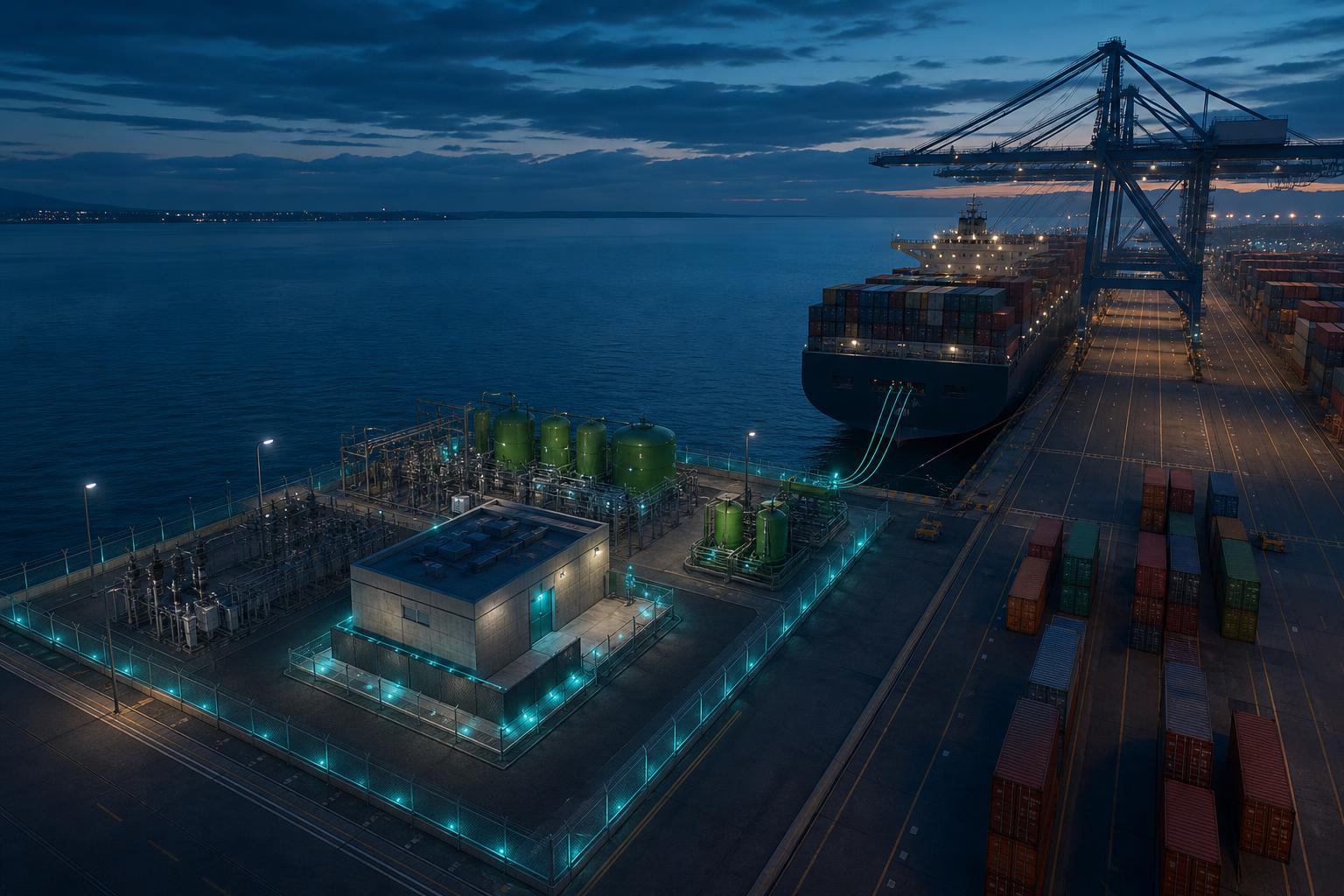
Attention in maritime nuclear has concentrated on the vessel. But a nuclear-capable shipping system also has to land somewhere: a port that can supply firm multi-MW shore power, run a resilient microgrid through grid disturbances, absorb high-temperature process heat, and receive future nuclear vessel calls under a settled security, regulatory and workforce regime.
Today those functions are handled by a constrained utility connection and diesel gensets. Shore power is the accepted answer for hotelling load, but it depends on interconnection headroom and port-side infrastructure that many hubs do not yet have — and terminal equipment and fuel handling need heat, not only electrons.
TidalCore studies that shore-side interface: what a port actually needs from a firm energy asset, and whether a compact reactor sited at or near the quay could supply it. That question — not a product claim — is what this study exists to answer.
One asset, two outputs
The proposed architecture takes a single sealed thermal source and splits it between electrical shore power and high-temperature industrial heat.
Electrical output
Sized in the study for berth shore power and terminal loads such as cranes, reefers, and yard equipment. Net output depends on power-conversion selection and site conditions.
Thermal output
Modeled high-temperature heat available for industrial process use, including potential low-carbon fuel synthesis. Co-product economics require independent validation.

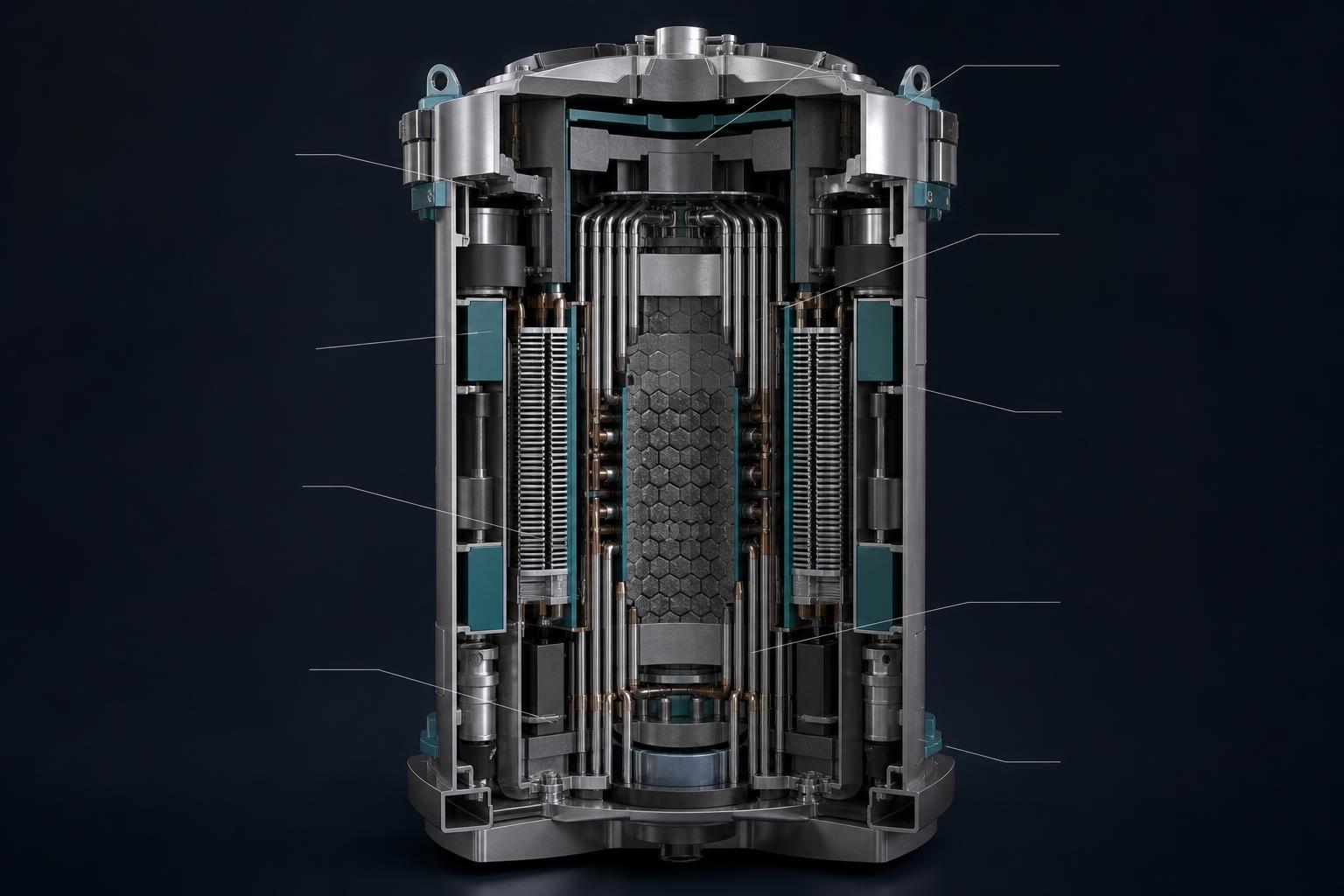
A TRISO fuel monolith surrounded by sodium heat pipes inside a sealed vessel — the core architecture thesis under study. Dimensions, mass, and refuelling interval are modeled targets.
System walkthrough →Interactive specifications →Four design choices, stated as hypotheses
Passive heat transport
Heat pipes are proposed for the primary loop to reduce reliance on active pumping and forced circulation. The approach is well documented in the literature; TidalCore's implementation requires independent analysis and testing.
Factory-oriented module
The study assumes a sealed, factory-assembled module to shift work off the port site. Manufacturing, transport, and licensing implications of that assumption are open questions.
High-temperature co-product heat
Targeting a high core outlet temperature makes process heat usable alongside electricity. Achievable temperatures and downstream integration are modeled, not measured.
Maritime siting thesis
Port sites bring specific constraints: land, security, marine interfaces, and multi-agency oversight. Mapping those constraints early is the core of the regulatory research track.

Visuals on this site are conceptual illustrations produced for the study. They depict proposed arrangements, not built hardware, and no port shown or referenced has reviewed or endorsed this work.
Work product, not promises
Everything below exists now and is reviewable. There is no hardware, no pilot site, no partner agreement, and no validated performance data — and we don’t suggest otherwise.
Concept dossier & system architecture
A written technical concept covering core layout, heat transport, power conversion, and the safety argument under development.
Interactive specifications & reduced-order models
Parametric models that expose the sensitivities behind the headline figures rather than hiding them.
Port market & deployment research
A comparative view of advanced reactor programs and where the maritime use case sits relative to them.
Regulatory pathway mapping
Research into the applicable NRC framework and the multi-agency interfaces a port site would involve.
IP development workflow
An internal process for capturing and drafting provisional filings as the architecture matures.
Sponsor & partner data room
A structured place for reviewers to access the evidence base and request gated material.
The port-energy thesis in 20 seconds
A short conceptual film summarising why maritime hubs need firm heat and power, and what the proposed architecture looks like. All imagery is illustrative.
Help turn the thesis into an independently reviewed engineering program.
Current work is focused on independent engineering review, port-site feasibility, regulatory scoping, and development partnerships. We’re looking to speak with investors, port authorities, utilities, engineering collaborators, national laboratories, and research sponsors.